Why Adhesives Matter in Plywood Manufacturing
Plywood is built by bonding thin wood veneers into strong, versatile panels. The adhesive you choose determines durability, water resistance, and compliance with global safety standards. At MICHELIN ResiCare, we go beyond performance: our solutions deliver health safety, sustainability, and regulatory peace of mind for Class 3 EN314 plywood applications.
Our Resin Innovations for Plywood
Since 2021, MICHELIN ResiCare has commercialized its first water-resistant Ultra-Low Emission Formaldehyde (ULEF) resin for plywood. This solution was designed as a first step to eliminate harmful substances while delivering superior performance.
Today, we are pioneering a nearly 100% biobased, formaldehyde-free resin that is safe, sustainable, and high-performing, compatible with your current production processes, favored by your workers, made of renewable carbons, reducing CO₂ emissions. Let it become your contribution to the European Green Deal while keeping plywood performance.
Introducing Resi4 Plywood:
Nearly 100% biobased formulation
Araminolic resin technology engineered for Class 3 EN 314 plywood applications
Monomers free of formaldehyde, phenol & melamine by design
REACH compliant, SVHC-free, no CMR pictograms nor endocrine disruptors
Low CO₂ emissions (<0.80–2.50 kg/kg)
European sourcing and longer shelf life
Class 3 bonding performance with various tree species (poplar, okoume, birch, pine and more to be tested)
Water-based formulation with no VOC (Volatile Organic Compounds) emissions
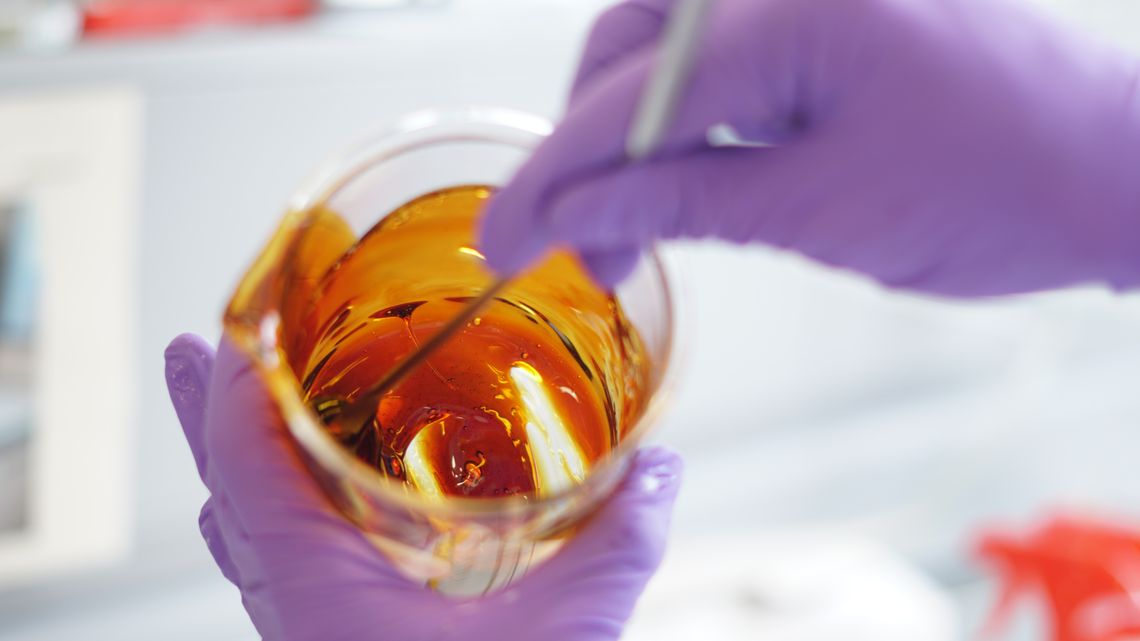
Easy identification with blackcurrant-colored resin (uncured)
Why Partner with MICHELIN ResiCare?
Our plywood adhesives are designed to help manufacturers meet health, safety, and sustainability targets while delivering superior bonding performance for structural panels and specialty applications. From construction to furniture and transportation, we provide solutions that reduce emissions and improve durability. Choosing MICHELIN ResiCare means working with resins that are “Safe & Sustainable” by design, REACH compliant, SVHC-free, with no regrettable substitution, no CMR pictograms, and no endocrine disruptors, all while using raw materials sourced from renewable resources. This combination ensures compliance with stringent regulations, supports your customers’ 2050 CO₂ roadmap, and builds European sourcing. Commercialization is planned from 2026, giving you a future-ready solution without compromising technical excellence or Class 3 water resistance performance.
Frequently asked questions
For more specific information, contact our team
plywood
Adhesive resins bond different wood-based components together, enabling the production of engineered wood products such as plywood, OSB, MDF/HDF, particle boards, glulam, CLT, and LVL.
It enhances natural characteristics, compensates for imperfections, valorizes co-products, and enables high-performance products for construction and furniture.
A brand by Michelin extending adhesion expertise to the wood market (plywood, MDF, OSB, particle boards, glulam, and LVL) & composites market (glass fiber, carbon fiber..).
In 2021, specifically for plywood. It is a class 3 ULEF (Ultra Low Emission Formaldehyde) resin.
They eliminate harmful legacy ingredients (formaldehyde, isocyanates, phenol, etc.), offer Class 3 water resistance, and are biosourced without SVHC molecules.
They are the core binder transforming raw timber into high-performance products like MDF, Plywood, and OSB.
Reliance on formaldehyde, phenol, and melamine (petro-based) which pose health risks and regulatory exposure.
No. They integrate seamlessly into existing manufacturing to minimize transition risks and disruptions.
Water-based, biosourced, NAF/ULEF compatible, SVHC-free, and reducing CO2 footprint.
Mass commercialization is ramping up from 2026, relying on industrial bio-based monomer production starting in 2027.